Randle McMurphy’s deterioration under electroshock
One Flew Over the Cuckoo's NestRandle McMurphy’s deterioration under electroshock is presented as a contest over who gets to define what the treatment means: Nurse Ratched treats his apparent resistance as a reason to escalate, while he performs fearlessness for the patients watching him. His jokes and defiance make him seem untouched, but involuntary signs of strain expose the cost; the later return of his body after a lobotomy makes the difference between temporary shock and lasting devastation unmistakable.
Treatment as Institutional Power
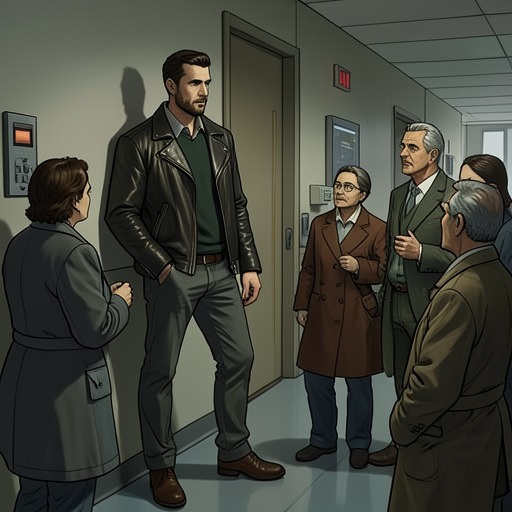
The ward’s use of electroshock is introduced through a process that is difficult for patients to mistake for voluntary care. Chief Bromden recalls being herded with the others to Building One under the explanation that they are receiving chest X-rays. The line passes a door marked X-RAY and another marked EENT, then a blank metal door behind which a patient screams. A person is wheeled out smoking; another, drugged and unsteady, stiffens his heels against the floor as attendants pull him toward the treatment table. The door closes, cutting off the struggle. This scene establishes the coercive atmosphere surrounding the treatment before McMurphy himself undergoes repeated shocks. When McMurphy asks what happens in the room, he reduces the procedure to electricity being sent through a person’s skull. The question is blunt, and its importance lies in what it changes: electroshock is no longer just another ward term, but an intervention whose physical force he has recognized. The evidence does not provide a clinical account of his brain or a diagnosis of the treatments’ effects. Instead, it shows the institutional sequence around them—staff decide when he will be taken, and his refusal to yield becomes part of the confrontation.
Learning the Cost of Resistance
McMurphy’s resistance changes as he learns more about the limits on his freedom. Earlier, he had pressed Nurse Ratched and encouraged other patients to defy her. Fredrickson warns that openly hostile behavior can lead to a patient being listed as potentially assaultive and sent to the Disturbed Ward; he says he has been sent there three times. The threat of electroshock and even an operation is part of the patients’ understanding of how the institution can answer resistance. Later, McMurphy discovers that many patients are voluntary while he is among the few who are committed. Harding explains that he is not committed, whereas McMurphy is. McMurphy asks whether the others have been deceiving him, then grasps that his position carries a different risk: he fears that antagonizing Nurse Ratched could add another year to his sentence. He admits that he has learned what the patients were using him for and that he must protect his own interests. This is not a simple surrender. It is a recalculation under unequal conditions, and it helps explain why his later confrontations with the treatment system have consequences he cannot dismiss as a wager or a joke.
Repeated Treatments and Defiant Performance
In the Disturbed Ward, McMurphy receives three more treatments during one week. Each time he begins to recover, Nurse Ratched arrives with the doctor and asks whether he is ready to face his problem and return to the ward for a cure. He answers with theatrical bravado, invoking sacrifice for his country and refusing to give up the ship. He bows to the men watching him, who grin at the performance, while Nurse Ratched takes the doctor away to authorize another treatment. The repetition makes the encounter a ritual: recovery brings another opportunity to submit, and his refusal brings another shock. His gestures sharpen the contrast between performance and vulnerability. Once, he pinches Nurse Ratched through the back of her uniform as she turns away, making her face red; the doctor is present, suppressing a grin. McMurphy tells Chief Bromden that the treatments are merely charging his battery and insists that he is not afraid. He refuses his capsules as well. Yet whenever the loudspeaker summons him to miss breakfast and walk to Building One, his jaw tightens and his face loses color. The bodily reaction contradicts the comic bravado without canceling it: he continues to resist, but the scene makes plain that the summons reaches him.
Visibility, Legend, and the Escape Plan
Nurse Ratched recognizes that McMurphy’s absence is strengthening his reputation among the patients. Because they cannot see how much the treatments are affecting him, she fears, he is growing into a legend. She decides to bring him back to the ward so that they can witness his vulnerability and see him in a shock stupor. Her strategy depends not only on treatment but on controlling its visibility: a weakened patient out of sight can remain a hero, while the same patient displayed in the day room can be made to look diminished. The patients anticipate this plan. Harding, Scanlon, Fredrickson, and Chief Bromden discuss how to persuade McMurphy that escape would be best for everyone. By the Saturday he returns, they have planned to set a mattress on fire after dark and rush him out when the firemen arrive. Their plan is formed around the likelihood that Nurse Ratched will keep giving him shocks whenever he recovers. But McMurphy’s return also collides with his arrangement to have Candy brought onto the ward for Billy. The escape plan reveals the patients’ changed role: they are no longer only watching McMurphy’s defiance but trying to protect him from the cycle of treatment. When he comes back, McMurphy again presents himself as exuberant and unbroken. He calls himself fully charged, spills mop water under the Nurses’ Station door, places butter on an attendant’s white suede shoe, and suppresses giggles at lunch. The conduct frustrates Nurse Ratched’s effort to display him as visibly diminished. Yet it should not be mistaken for proof that treatment has had no cost. The earlier pallor and tightened jaw have already shown what his performance conceals, and her plan to expose him in a stupor confirms that his condition is a central struggle over how the other patients see him.
Lasting Damage and Narrative Significance
After the nighttime party, McMurphy is sitting with Candy, tired and visibly unwell. His eyes are reddened, he presses the heels of his hands to his temples, yawns, and keeps licking a tongue that looks coated with cough syrup. Even so, he holds on to his grin and sometimes laughs at what Nurse Ratched uncovers. The scene gives his exhaustion a concrete presence but does not identify it as a direct effect of electroshock; it follows the party, and the narrative does not assign it a single cause. Its significance is in the continuing contrast between his physical depletion and his refusal to surrender the outward signs of resistance. The final image makes the stakes of deterioration unmistakable. Three weeks after McMurphy has been gone, the ward door opens and attendants wheel in a gurney bearing a chart marked with his name and the word LOBOTOMY. His head rests in a dented pillow; red hair frames a milk-white face, with heavy purple bruises around the eyes. The patients read the chart, look at him, and fall silent before Scanlon rejects the figure as not being McMurphy. The return does not merely reveal that McMurphy has been harmed: it confronts the ward with the apparent erasure of the person whose visible resistance had sustained them. Set beside the repeated shocks, the lobotomy marks a decisive and more lasting destruction of agency, while the patients’ response shows that the struggle over McMurphy’s meaning continues even after he can no longer enact it himself.